
Growing Fast Without Growing Apart: Why Turnover and Employee Commitment Matter More Than Ever

July 30, 2026
“Retention isn’t a human resources problem — it is a leadership outcome. And commitment isn’t luck; it’s science.”
Organizations today face a perfect storm of change. Rapid growth, geographic expansion, artificial intelligence (AI), demographic shifts, and the arrival of Generation Z and Generation Alpha into the workforce are simultaneously reshaping how work is performed and how employees experience it. Understanding employee turnover and employee commitment has therefore become one of the most practical applications of Industrial and Organizational (I-O) Psychology. The organizations that successfully apply this science will gain a competitive advantage not because they have fewer people problems, but because they solve them more effectively. As the saying might go, “People are still your greatest asset — especially after the robots finish the paperwork.”
Although frequently discussed together, turnover and employee commitment are not the same phenomenon. Turnover refers to employees voluntarily or involuntarily leaving an organization, while commitment describes the psychological attachment employees feel toward their employer. A highly committed employee may leave because of military relocation, family obligations, or a better career opportunity. Conversely, a poorly committed employee may remain simply because alternative employment is unavailable. Industrial and Organizational Psychology provides evidence-based methods for understanding and managing both outcomes rather than relying on intuition or management folklore.
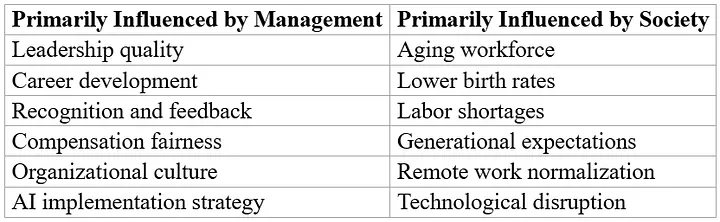
Rapid organizational growth often creates conditions that unintentionally increase both turnover and low commitment. Organizations expanding into new geographic markets frequently promote inexperienced supervisors, hire employees faster than they can effectively onboard them, and struggle to maintain a consistent organizational culture across locations. Research consistently demonstrates that management-controlled variables — including leadership quality, organizational support, career development opportunities, fairness, communication, and job design — substantially influence both turnover intentions and organizational commitment.¹,²
At the same time, organizations must distinguish these management-controlled influences from broader macro-level societal changes. Aging populations in many developed countries, lower birth rates, increasing workforce diversity, remote work expectations, and changing attitudes toward work-life integration affect virtually every employer regardless of management quality. Likewise, younger workers often expect frequent coaching, meaningful work, flexible schedules, rapid skill development, and opportunities for advancement earlier in their careers than previous generations. Deloitte’s Global Human Capital Trends reports consistently conclude that organizations thriving during periods of disruption invest simultaneously in leadership capability, organizational culture, technology, and workforce development rather than viewing these priorities as competing investments.¹¹
 \
\
Figure 1. Organizational Factors Have Greater Direct Influence on Commitment Than Macro Trends
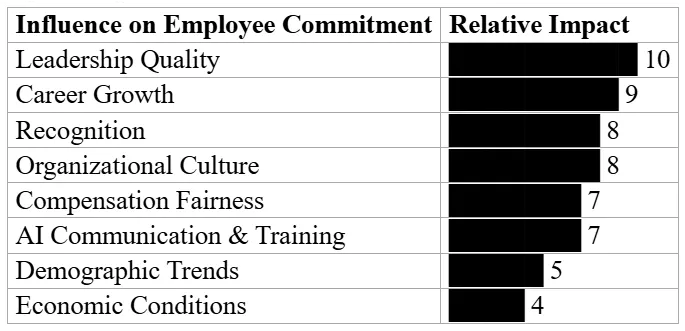
Illustrative model synthesizing findings from turnover and organizational commitment research.
The distinction between management practices and societal trends is critically important because Industrial and Organizational Psychology focuses on identifying which variables organizations can actually influence. Leaders cannot reverse demographic changes or eliminate labor shortages, but they can improve hiring practices, develop better supervisors, build stronger organizational cultures, and create workplaces that encourage employees to remain committed even during periods of uncertainty.
The United States military provides an excellent illustration. Recent recruiting shortfalls have reflected macro-level demographic changes, historically low unemployment, and increased competition for young talent. However, military leaders have simultaneously invested in housing improvements, family support programs, leadership development, expanded career flexibility, and quality-of-life initiatives to improve retention among currently serving personnel. These initiatives acknowledge that while society influences recruiting, organizational practices continue to shape commitment and reenlistment decisions.³
A similar lesson can be observed within the hospitality industry. Following the COVID-19 pandemic, hotel companies experienced unprecedented turnover while simultaneously struggling to recruit qualified employees. Marriott International responded by expanding leadership development programs, strengthening internal promotion pathways, increasing employee recognition efforts, and investing in career mobility initiatives. Although these efforts cannot eliminate labor market competition, they directly address organizational factors that influence employee commitment and voluntary turnover.⁴
Perhaps the most significant emerging challenge is the widespread adoption of agentic AI and workplace automation. AI systems increasingly schedule employees, answer customer questions, assist decision making, perform predictive maintenance, monitor quality, and automate administrative work. Ironically, the technology designed to improve productivity can either strengthen or weaken employee commitment depending entirely upon how organizations implement it.
Employees who view AI as a tool that eliminates repetitive work often report higher engagement and greater job satisfaction. Employees who perceive AI as surveillance technology or a replacement for their expertise frequently report lower trust, increased anxiety, and stronger intentions to seek employment elsewhere. Recent analyses by McKinsey & Company estimate that generative AI will substantially reshape millions of jobs over the next decade, making workforce reskilling, organizational adaptability, and effective change management strategic necessities rather than optional human resource initiatives.¹⁰
This reality demonstrates why Industrial and Organizational Psychology is becoming increasingly important as organizations adopt AI agents throughout their operations. Successful AI implementation depends less on software installation than on leadership communication, organizational trust, employee involvement, effective training, and thoughtful job redesign. Organizations ignoring these human factors may discover that the most expensive cost of automation is not purchasing the technology — it is losing experienced employees who understand how the business actually works.
The scientific foundations supporting these conclusions have been established over decades of research. Mobley’s influential turnover model demonstrated that employees typically move through identifiable psychological stages before voluntarily leaving an organization, making turnover understandable and, to some degree, predictable.⁵ Likewise, Meyer and Allen’s Three-Component Model demonstrated that employee commitment consists of affective, continuance, and normative commitment, each influencing workplace behavior in different ways.⁶ Together, these seminal theories remain foundational to Industrial and Organizational Psychology because they connect psychological processes directly to measurable organizational outcomes.
Business publications increasingly reinforce these academic conclusions. Reports from Harvard Business Review, MIT Sloan Management Review, Gallup, McKinsey & Company, and Deloitte consistently conclude that leadership quality, meaningful work, continuous learning, organizational trust, and thoughtful AI implementation have become durable competitive advantages in attracting and retaining talented employees during periods of technological disruption.⁷,⁸,⁹,¹⁰,¹¹
Ultimately, organizations entering the AI era face a straightforward but consequential choice: automate work while neglecting people, or automate work while investing even more intentionally in people. The latter approach recognizes that turnover and employee commitment are not simply human resource metrics — they are measurable organizational outcomes rooted in the science of Industrial and Organizational Psychology. As technology accelerates, labor markets tighten, and workforce expectations continue to evolve, organizations applying this science will discover that their greatest competitive advantage remains delightfully old-fashioned: committed people who choose to stay.
Footnotes
- Porter, L. W., Steers, R. M., Mowday, R. T., & Boulian, P. V. (1974). Organizational Commitment, Job Satisfaction, and Turnover Among Psychiatric Technicians. Journal of Applied Psychology, 59(5), 603–609.
- Hom, P. W., Lee, T. W., Shaw, J. D., & Hausknecht, J. P. (2017). “One Hundred Years of Employee Turnover Theory and Research.” Journal of Applied Psychology, 102(3), 530–545.
- U.S. Department of Defense. (2024–2025). Military Recruiting and Retention Reports; Congressional Research Service. Defense Primer: Recruiting and Retention.
- Marriott International Careers; Lodging Magazine; Hotel Dive. (2023–2025). Articles on hospitality workforce retention, internal mobility, and employee development.
- Mobley, W. H. (1977). “Intermediate Linkages in the Relationship Between Job Satisfaction and Employee Turnover.” Journal of Applied Psychology, 62(2), 237–240. (Seminal turnover literature.)
- Meyer, J. P., & Allen, N. J. (1991). “A Three-Component Conceptualization of Organizational Commitment.” Human Resource Management Review, 1(1), 61–89. (Seminal employee commitment literature.)
- Harvard Business Review. (2023–2025). Articles on employee experience, retention, leadership, organizational culture, and AI-enabled management.
- MIT Sloan Management Review. (2023–2025). Articles on AI adoption, organizational trust, workforce transformation, and change management.
- Gallup. (2024). State of the Global Workplace 2024 and related workplace engagement research.
- McKinsey & Company. (2023–2025). The Economic Potential of Generative AI, Superagency in the Workplace, and related reports on AI, workforce transformation, and talent management.
- Deloitte. (2024–2025). Global Human Capital Trends reports on leadership, workforce resilience, organizational culture, AI, and the future of work.
Contributor’s Note: Mark Wilson, Chief Analytics Officer and Senior Business Advisor. Comments, suggestions, reactions, examples, and questions are welcome. Reach me at mark.wilson@horizonperformance.com
Growing Fast Without Growing Apart: Why Turnover and Employee Commitment Matter More Than Ever was originally published in Horizon Performance on Medium, where people are continuing the conversation by highlighting and responding to this story.