

What a Difference a Year Can Make
We often overestimate what we can accomplish in a single day and underestimate what we can do — or undo — over the course of a year. While commonly repeated, this insight points to a real leadership hazard: meaningful change rarely happens all at once. Instead, it accumulates quietly, often unnoticed, until the results become impossible to ignore.
Consider the following example.
An Athletics Director — experienced and well respected — conducts the same kickoff meeting with each of his teams every year. The format is consistent. He welcomes the team, outlines expectations, reinforces departmental values, and shares stories drawn from elite team performances.
One year ago, one team arrived early. All players wore team-issued gear. The coaching staff was present. Body language suggested readiness and engagement.
One year later, the same meeting with the same team looked very different. Players trickled in just before the start time, with several arriving late. One athlete sat in the front row shirtless. Coaches were absent, replaced by a junior staff member. Engagement was noticeably poor.
That evening, the Athletics Director remarked to his wife, “This team is in trouble.”
Nothing dramatic had occurred. No single incident stood out. But the standard had clearly changed.
Months later, observers began describing the program using familiar language: underperforming, lacking heart, poor effort. Fans and media pointed to the scoreboard and searched for explanations. What they were identifying were symptoms — not causes.
A Dangerous Drift
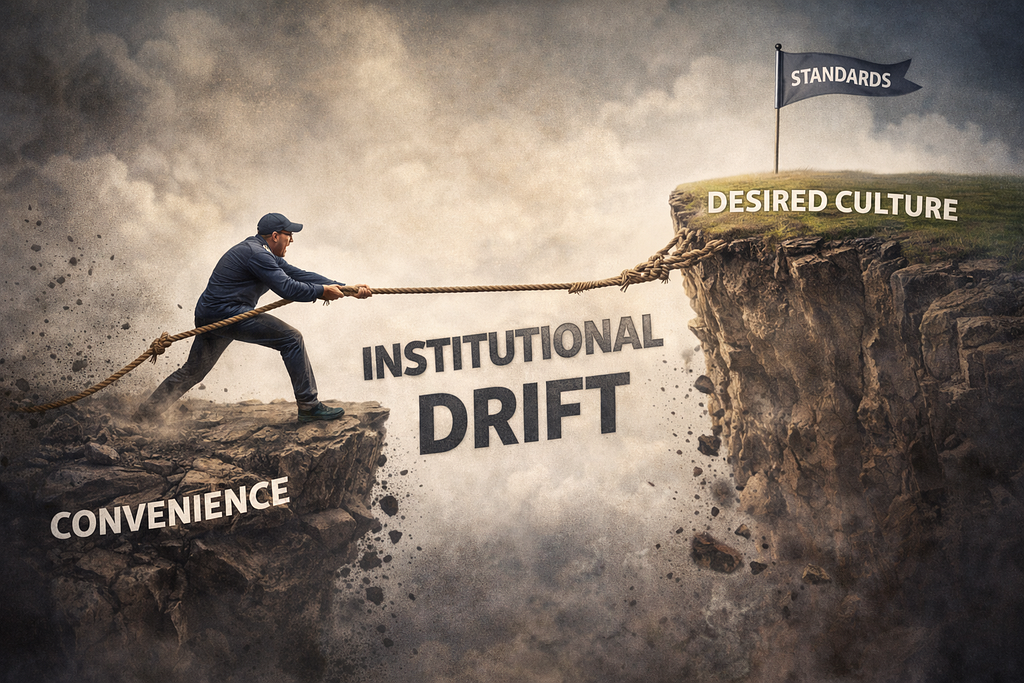
This situation was not the result of attitude problems or a lack of character. It was a case of institutional drift.
Institutional drift is a well-documented organizational phenomenon in which an organization gradually moves away from its stated standards and values — not because leaders decide to change them, but because those standards are no longer actively reinforced. Organizational theorists have long warned that institutions naturally drift unless leaders consistently re-infuse purpose and expectations through attention, reinforcement, and action.¹
Culture rarely collapses suddenly. More often, it erodes through hundreds of small moments:
- When tardiness goes unaddressed
- When dress standards become optional
- When leaders stop checking the “little things”
- When expectations are assumed rather than clearly restated
Over time, the mindset shifts. The standard softens. Behavior follows.
This pattern is not unique to athletics. Similar dynamics appear in military units where customs become inconsistent, in classrooms where expectations vary by teacher, and in training programs where rigor is slowly lowered to reduce attrition.
When leaders are not deliberate about standards, organizations tend to drift toward convenience rather than excellence.
The hard truth is this: leaders do not get the culture they say they want. They get the culture they consistently reinforce — or allow. What is tolerated quietly becomes the new standard.
Why “Heart” Is a Terrible Start
When teams underperform, leaders often default to language about character: heart, toughness, commitment, buy-in. The assumption is that the issue lies somewhere inside the individual.
Research suggests otherwise.
Decades of social and organizational psychology indicate that behavior precedes identity. According to Self-Perception Theory, individuals come to understand who they are by observing what they repeatedly do.² Identity and character are inferred from consistent behavior, not formed independently of it.
In practice, this means that disciplined behavior, repeated over time, produces disciplined identity. Casual behavior, repeated over time, produces casual norms. This is why efforts to “fix attitudes” without addressing daily behaviors are rarely effective.
From an organizational psychology perspective, character is relatively stable and slow to change, while behavior is observable, situational, and immediately adjustable.³ Leaders can set expectations, shape environments, reinforce norms, and correct actions. What they cannot directly command are motivation, grit, or heart. Those qualities tend to emerge only after consistent behavioral standards are enforced.
Another well-established finding reinforces this point: situations influence behavior more powerfully than personality. Kurt Lewin summarized this decades ago with a simple equation — Behavior = Person × Environment.⁴ When standards erode, even individuals with strong character will drift. Strong systems protect against individual variance; weak systems amplify it.
Over time, small behaviors become habits. Habits form norms. Norms define culture. Culture drives performance. Habit research shows that many of these patterns form automatically, without conscious intent, which explains why drift often goes unnoticed until outcomes deteriorate.⁵
By the time leaders begin questioning character, they are often confronting a set of uncorrected habits that have hardened into culture.
The Antidote to Drift: Seven Ways to Reclaim the Standard
Preventing institutional drift requires far more than good intentions. It requires leaders who are deliberate, consistent, and willing to invest attention in the seemingly mundane details that ultimately shape culture. The following seven practices provide a practical framework for anchoring standards before erosion takes hold.
1. Define the Standard Early — and Say It More Than Once
Leaders often assume expectations are understood, particularly by returning members of the organization. In reality, assumption is one of drift’s greatest accelerants.
In today’s transfer-portal and high-turnover environment, many programs are effectively rebuilding their team every year. Few holdovers remain to model the standard, and even fewer may feel empowered to enforce it. That means leaders are not refining culture — they are reestablishing it.
Standards must be articulated clearly, visually, and repeatedly. The language used to describe them should be consistent and deliberate, living not only on walls and handbooks but in daily conversations and decisions.
Repetition is not redundancy; it is reinforcement. Clarity is not micromanagement; it is leadership.
2. Be Present Where Expectations Matter Most
Presence is one of the most powerful tools leaders have, and its absence is often louder than any speech. When leaders show up early and often — especially at the beginning of a season or cycle — they communicate priority. When they don’t, they communicate permission.
Leaders cannot be everywhere, but they must be somewhere that matters. Moments that establish tone — first meetings, early practices, transitions between phases — carry outsized cultural weight.
This responsibility does not rest solely on the head leader. Assistant coaches and key staff must be trained, aligned, and trusted to mirror this emphasis. They are not merely support personnel; they are extensions of leadership and stewards of the standard. Culture scales when alignment deepens across the staff.
3. Inspect What You Expect
Standards that are not inspected inevitably soften. Leaders may not personally inspect every domain, but they are responsible for building systems that do.
Arrival times, attire, posture, engagement, and preparation are not trivial details — they are early indicators of cultural health. Effective leaders establish accountability loops across all environments: the weight room, classroom, locker room, meeting room, and practice field.
These systems must be visible so everyone knows they exist, active so they function consistently, and bidirectional so they identify both alignment and gaps. Every interaction becomes a culture-shaping moment. Leaders either reinforce discipline or allow drift through inattention.
4. Correct Early, Not Later
Small deviations rarely correct themselves. Left unaddressed, they become assumptions, and assumptions quickly harden into norms.
Effective correction is immediate, specific, and proportional. It does not require theatrics or public displays of authority. In fact, small, quiet, consistent course corrections are often far more effective than dramatic responses.
The first mistake is an error. The second, if ignored, becomes a signal. The longer leaders wait, the louder their silence becomes.
5. Reinforce Alignment Through Consequences and Stories
Culture is shaped not only by what leaders correct, but by what they celebrate. Leaders should be intentional about catching individuals living the standard and reinforcing those behaviors publicly. Stories of alignment create social proof and accelerate learning across the group.
At the same time, deficiencies must be addressed calmly and directly. Early, clear feedback — delivered with the right tone — communicates seriousness without eroding trust. Volume is rarely necessary; consistency is.
Positive reinforcement and corrective action work together to clarify what truly matters.
6. Train for the Standard — Don’t Just Talk About It
If a behavior is important enough to expect, it is important enough to practice. Many leaders talk about culture, but elite programs train it.
This means designing short, high-repetition opportunities to reinforce key behaviors: punctuality, uniform standards, sideline presence, communication habits, and huddle posture. Correction and reinforcement should be normalized as part of daily operations, not reserved for moments of failure.
Organizations do not rise to the level of their intentions. They fall to the level of their training.
7. Enlist Peer Enforcers
Culture cascades fastest through peers, not policies. Leaders who rely solely on top-down enforcement eventually experience fatigue and diminishing returns.
Identifying a small group of respected members and equipping them to model and reinforce standards multiplies cultural influence. These individuals should be given specific language, clear authority, and visible backing from leadership.
Peer accountability strengthens ownership and ensures that standards are upheld even when leaders are not present. Culture becomes durable when the group — not just the staff — feels responsible for protecting it.
Reclaiming the standard does not require radical change. It requires sustained attention to behaviors that seem small but compound over time.
What a difference a year can make?
More importantly, what a difference deliberate leadership makes.
Footnotes and Sources
[1] Selznick, P., Leadership in Administration (University of California Press, 1957) — foundational organizational theory describing how institutions drift from stated values through routines, compromises, and inattention unless leaders actively reinforce purpose and standards.
[2] Bem, D. J., Self-Perception Theory, in Advances in Experimental Social Psychology (Vol. 6, 1972) — research demonstrating that individuals infer identity and attitudes from repeated behavior.
[3] Lewin, K., Principles of Topological Psychology (McGraw-Hill, 1936) — classic formulation of Behavior = Person × Environment, emphasizing the power of situational context.
[4] Wood, W., & Neal, D. T., A New Look at Habits and the Habit–Goal Interface, Psychological Review (2007) — evidence that repeated behaviors form automatic habits that shape norms and long-term outcomes.
[5] Avolio, B. J., & Luthans, F., The High-Impact Leader (McGraw-Hill, 2006) — leadership research showing that traits like confidence, resilience, and discipline develop through context and reinforcement rather than direct instruction.
Why Standards Fail Long Before Results Do was originally published in Horizon Performance on Medium, where people are continuing the conversation by highlighting and responding to this story.