
Human Capital Management in 2026: Where the “People Stuff” Gets Real

January 15, 2026
Human capital management (HCM) is the practical application of industrial and organizational (I-O) psychology to build, deploy, and sustain a workforce that can execute strategy — on time, on budget, and ideally without setting anything (or anyone) on fire. People analytics helps, but it’s the instrument panel, not the aircraft.
HCM vs. People Analytics (same kitchen, different jobs)
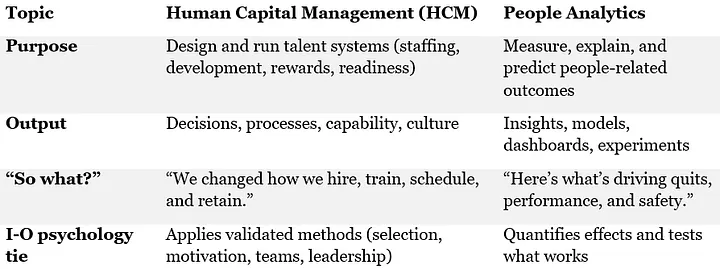
People analytics is about analyzing people data to solve business problems; HCM is where you actually change the system (and absorb the complaints) [1].
Emerging issues shaping HCM right now
1) Skills are becoming the new currency.
Organizations are shifting toward skills-first approaches and “human value” in an AI-heavy workplace: not just who you are, but what you can do — and learn next [2][3]. The World Economic Forum projects substantial skill change through 2030, pushing continuous upskilling from “nice-to-have” to “rent is due” [3].
2) Pay transparency is moving from trend to terrain.
New state pay transparency laws taking effect in 2025 are nudging employers toward clearer ranges and cleaner job architectures (translation: fewer “competitive salary” mysteries) [4].
3) Frontline retention is still a boss fight.
Turnover is not a “culture problem” alone; it’s job design, scheduling, manager capability, and labor-market reality — classic I-O topics like motivation, stress, and fairness.
Mini-graph: Annual average quits rate (2024)
(Each █ ≈ 0.5 percentage points)
- Leisure & Hospitality: 3.9% ████████
- Total (all industries): 2.1% ████
- Construction: 1.7% ███
- Government: 0.8% ██
Source: U.S. BLS JOLTS annual average quits rates [5].
Two real-world examples (where HCM earns its keep)
U.S. Army: matching talent to missions.
The Army’s shift toward talent-based management — supported by systems like IPPS-A’s Soldier Talent Profile and market-style assignment processes — reflects applied I-O psychology: better person–job fit, improved development pathways, and more transparent opportunities [6][7]. It’s HCM because it changes how people are assigned and developed, not just how data is reported.
Construction: the workforce shortage as a delivery risk.
AGC reports that a large majority of firms struggle to find workers, with shortages contributing to project delays [8]. HCM responses are practical: tighter selection, faster onboarding, competency-based training pipelines, supervisor development, and retention practices that reduce churn (because replacing a crane operator is not like replacing a stapler).
One academic anchor (because science is the secret sauce)
I-O research consistently finds that higher-validity selection methods (e.g., structured interviews, work samples) improve performance and have meaningful economic utility — exactly the kind of evidence HCM should operationalize [9].
Catchy phrase: “Validated beats vibes.”
Footnotes and Sources
[1] CIPD, People Analytics (factsheet) (Feb 7, 2025).
[2] Deloitte, 2025 Global Human Capital Trends (overview/insights).
[3] World Economic Forum, The Future of Jobs Report 2025 and related summary statistics (skills change through 2030).
[4] SHRM, Ensure Compliance with New State Pay Transparency Laws in 2025 (Jan 21, 2025).
[5] U.S. Bureau of Labor Statistics (BLS), JOLTS Table 22, Annual average quits rates by industry (2024 values).
[6] U.S. Army IPPS-A, Talent Management / Soldier Talent Profile.
[7] U.S. Army, Officers: Your Guide to the Talent Alignment Marketplace (Army.mil, Oct 22, 2024).
[8] Associated General Contractors of America (AGC), Construction Workforce Shortages (Aug 28, 2025) and/or 2025 Workforce Survey Analysis (AGC/NCCER).
[9] Schmidt, F. L., & Oh, I.-S., The Validity and Utility of Selection Methods in Personnel Psychology: Practical and Theoretical Implications of 100 Years of Research Findings (2016).
Contributor’s Note:
Mark Wilson, Chief Analytics Officer and Senior Business Advisor. Comments, suggestions, reactions, examples, and questions are welcome. Reach me at mark.wilson@horizonperformance.com.
Human Capital Management in 2026: Where the “People Stuff” Gets Real was originally published in Horizon Performance on Medium, where people are continuing the conversation by highlighting and responding to this story.