

Here at the end of Black History Month, I’m thinking about John Lewis. But then, I think about John Lewis at some point nearly every month.
Lewis played a pivotal role in the American Civil Rights movement. Many would say his most profound demonstration of leadership occurred in 1965 on Bloody Sunday in Selma, Alabama. And Selma played pivotal role in my life, as our family lived there for a year starting in August 2019.
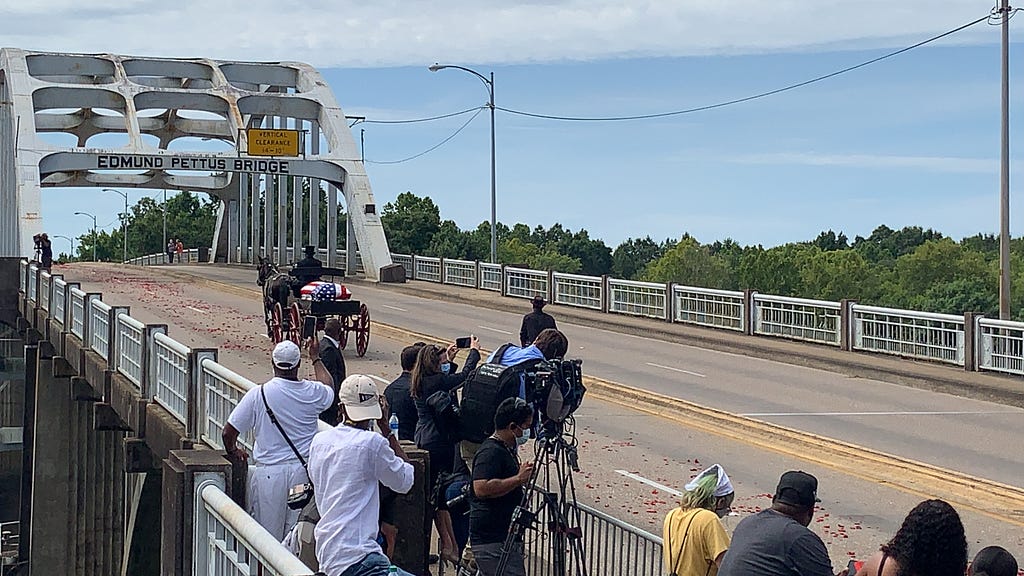
On July 26, 2020, John Lewis crossed the Edmund Pettus Bridge in Selma for the final time, his casket traversing the Alabama River, draped in an American flag, pulled by a horse drawn carriage.
That morning, my son and I stood atop a decorative brick wall on the west side of Broad Street, at the base of the bridge. Our perch was just high enough to allow us see over the bank of news cameras, positioned beside the local officials who shouted “good trouble” as Lewis’ carriage rolled past.
Like everyone else around us, we clapped. We applauded John Lewis for his moral conviction. More significantly, we applauded John Lewis for the courage required to live his moral conviction.
Lewis suffered personal harm, and not on one occasion, for his courage; he modeled what Robert Greenleaf said of servant leaders, that they are “not seekers after solace,” meaning such leaders do not pursue external comforts…or safety. Rather, these “able leaders” have “their own personal serenity,” which permits them to be “usually sharply awake and reasonably disturbed.”
Certainly, John Lewis’ life epitomized sharply awake and reasonably disturbed.
As a college student in Nashville, barely 20 years old, he organized sit-ins resulting in his arrest, yes, but also in the desegregation of lunch counters in the city. The following year, 1961, he was one of the 13 original Freedom Riders endeavoring to travel by bus from Washington DC to New Orleans; at bus terminals in the South, Lewis and other riders endured physical beatings and arrests — he even spent 40 days in a Mississippi state penitentiary. Two years later, Lewis was back in DC, helping to organize The March on Washington for Jobs and Freedom; in the concluding lines of his speech at the event, the 23-year-old Lewis challenged the audience, and the country, with: “Wake up America! Wake up! For we cannot stop, and we will not and cannot be patient.”
Lewis was imploring America to wake up to — become aware of — the painfully slow pace at which governments of all levels were recognizing the equality of all skin tones.
In a previous installment, I addressed awake-ness, asking: “Are you a woke leader? If not, why not?”
(Of course, woke has a distinct cultural meaning, historically. And though I do know what the term meant originally, I don’t know what it means these days, truly. People [leaders?] on both sides of the political aisle have sufficiently confused woke by sufficiently weaponizing it. Consequently, the previous blog stuck to the grammatical essence of woke, discussing the term as the past tense and the past participle of wake — under the premise that awake is aware is effective as a leader.)
The most honest, realistic answer to “If not, why not?” is because being a leader who is sharply awake and reasonably disturbed is…incredibly demanding, draining. Because not only must such leaders be full of conviction and courage but also must they be poured out for individuals and/or for causes.
How does that sound?
To John Lewis, that would, on multiple levels, sound right. If he could, Lewis would tell you how simultaneously necessary and wearying — and rewarding — being that kind of “woke” leader is.
And the people who worked around him would tell you the same — as you can read in a memo written by a San Francisco volunteer to the movement, one Ms. Bartlett, to the SNCC core team in Atlanta, concerning Lewis, on December 11, 1965. I’ll leave you with this…first-hand account about a tireless-but-tired leader whose legacy is still leading others, including me.
Be it herewith noted that John Robert Lewis has been traveling extensively for the last month and a half speaking continuously in all parts of these United States on behalf of the Student Nonviolent Coordinating Committee, of which he is chairman.
Be it herewith also noted that John Robert Lewis, having been in the Bay Area this past weekend, discharged his responsibilities with an unusual amount of care, concern and regard for the movement he represents and for the people with whom he came in contact. May his attention to details and his consideration for each person he spoke to be noted. May his devotion to the ideals of the movement, as expressed by his speeches, be considered. May the responsiveness on the part of his many audiences (approximately 3.5 per day, excluding days of travel) be noted. May his patience in the face of trivia, irritating situations, and long, demanding speechifying be noted.
Speaking as one who acted as chauffer this past weekend, may I recommend for your observation that John Robert Lewis is tired (me, too) and that he needs a Rest. I had the illusion most of the time that I was driving a hearse, because the person contained therein resembled a corpse more than any other thing, so great was his exhaustion.
Hoping that you will consider the above information seriously and act upon it will all judiciousness, I remain.
Yours in freedom,
Penny
Woke: Too was originally published in Horizon Performance on Medium, where people are continuing the conversation by highlighting and responding to this story.